Telerehabilitation after stroke: interpreting the evidence and designing the care pathway
A delivery model that needs to be designed
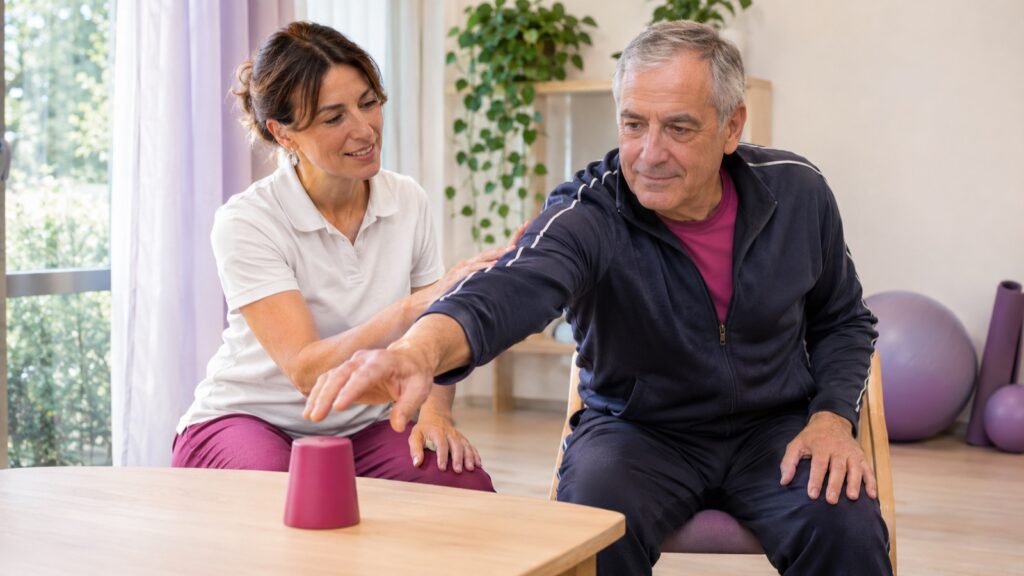
Telerehabilitation after stroke makes it possible to organise some rehabilitation activities through remote communication tools. The term describes a delivery model, not a single treatment. Supervised exercise, support after discharge and communication-focused activities have different objectives. To interpret a study, it is necessary to understand which intervention was assessed, in whom and against which alternative.
This also matters for a clinic introducing a service. Before choosing a platform, the team needs to describe the pathway: clinical objectives, frequency, professional responsibilities, in-person appointments and how difficulties will be handled. An internet connection alone does not define a complete rehabilitation programme.
The Cochrane reference and its date
Telerehabilitation services for stroke, published by Laver and colleagues in 2020, includes 22 studies with 1,937 participants and literature searches up to June 2019. Interventions and comparisons varied considerably, and evidence quality was generally low or moderate. Some comparisons found no significant differences in daily activities, but this does not demonstrate universal equivalence between remote and in-person care.
The review included no cost-effectiveness evaluations. It is a dated, bounded reference, not evidence of effectiveness for a particular device or a complete account of research in 2026. An operational protocol also requires an update of the relevant literature and the clinical guidance used by the organisation.
From a general question to a clinical question
Asking whether telerehabilitation “works” is too broad. A more useful question identifies the function to be recovered, the stage of the pathway, the level of support and the outcome to observe. Improvement in a digital task does not necessarily mean meaningful change in everyday life. The plan must connect the measurement to an objective agreed with the person.
The clinical team can define in advance what it will consider a useful result and when reassessment will take place. Service feasibility, adherence and functional outcomes should be distinguished: they are related but not interchangeable. A service that is easy to use may be insufficient for a particular objective; a potentially useful intervention may be impractical in a particular environment.
Suitability, supervision and the ability to change course
Individual assessment must precede the programme. The professional considers the person’s condition, understanding of instructions, communication, environment and available support. Suitability should be reassessed over time. It is not a permanent label and cannot be inferred from one automated measurement or an organisational preference.
The service must explain who reviews the data, how often and how patients can ask for help. The team needs criteria for pausing an activity, requesting contact or arranging an in-person assessment. Asynchronous monitoring must not be presented as continuous supervision. People should understand the limitations of the channel and receive clinical instructions consistent with their pathway.
Measuring the service without confusing outcomes
A pilot can record scheduled and completed sessions, technical difficulties, support requests, withdrawals and professional time. These data help assess sustainability. Clinical measures must instead be selected by the team and interpreted within the assessment, without turning a dashboard into a diagnosis.
It is also useful to document why someone does not participate or stops. Excluding people who experience difficulties can make the service appear more accessible than it is. Programme changes, adverse events and communication problems should be recorded according to organisational procedures. Service quality depends on recognising and addressing these limitations.
Where technology fits
Digital solutions can be assessed as tools supporting a pathway defined by the professional. For K•HERO, the assessment must concern the functions actually available, technical documentation and intended context. General evidence on telerehabilitation does not automatically transfer to the product.
Before moving from a demonstration to a service, agree who trains users, who provides support and which data will be reviewed. The decision should preserve practical alternatives: in-person delivery, additional support or stopping the digital approach when it does not meet the person’s needs.
Sources and further reading
Laver KE et al. Telerehabilitation services for stroke. Cochrane Database of Systematic Reviews, 2020; CD010255. DOI and review. Literature searches up to June 2019.
For information only. Decisions about individual care pathways are the responsibility of the clinical team.
More from K•HERO Insights
- How to increase rehabilitation capacity without increasing headcount
- Rehabilitation at home: building continuity between the clinic and home
- Caregivers and digital rehabilitation: supporting the person without overburdening the family
- AI and Computer Vision in rehabilitation: from movement measurement to clinical decisions